Presented on Windows Azure at Hartford Code Camp

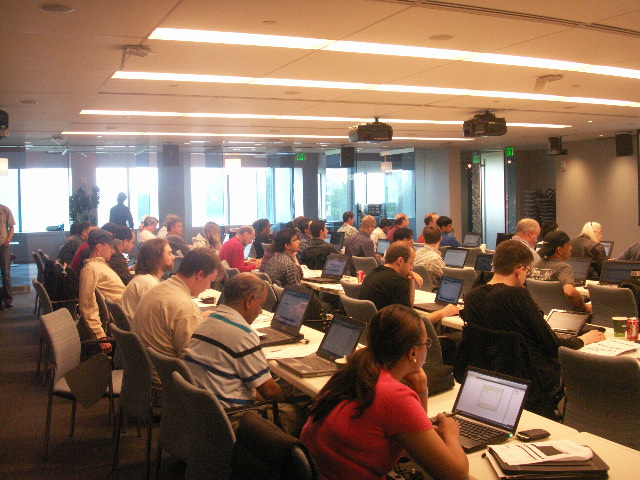
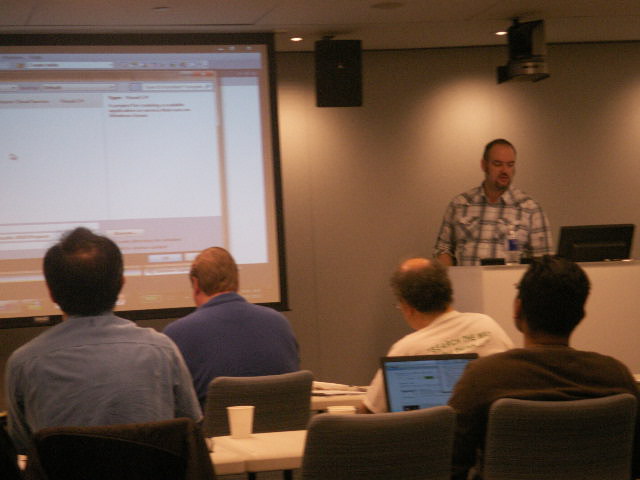
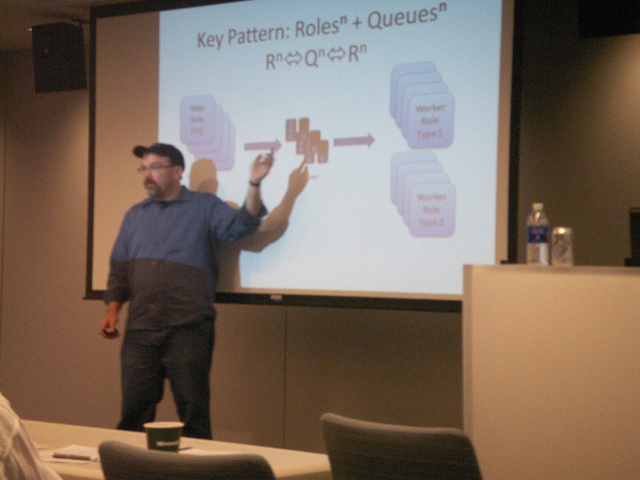
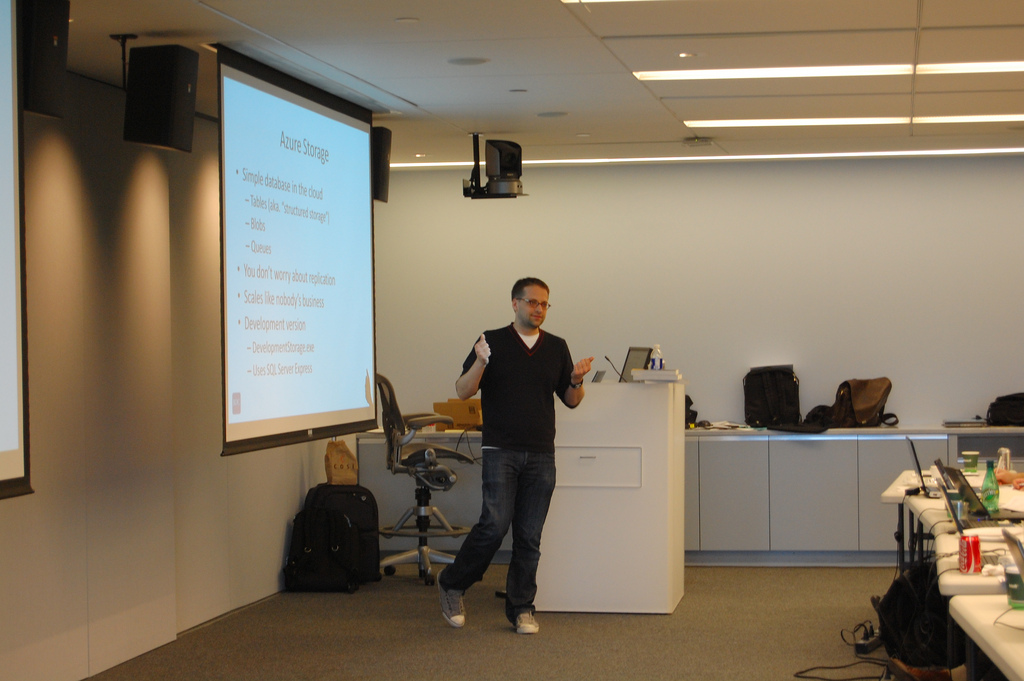
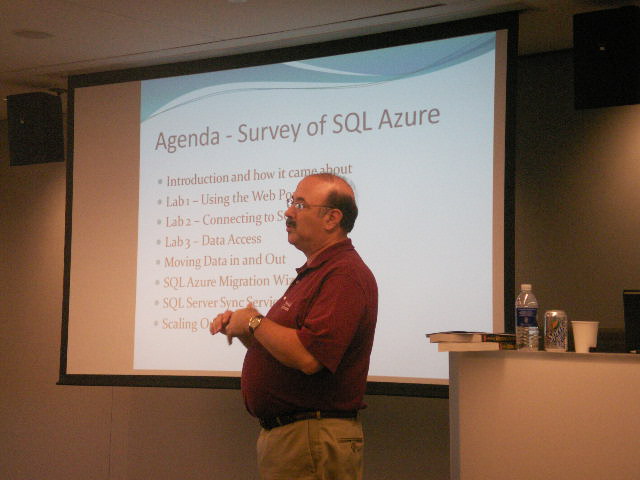
Today at Hartford Code Camp #3 in Connecticut, I presented two talks on Windows Azure.

The first talk was an introduction to Cloud Computing, with a Microsoft slant towards Windows Azure. The second drilled into the Two Roles and a Queue (TRAAQ) design pattern – a key pattern for architecting systems for the cloud.

The PowerPoint slides are available here:

Also plugged the Boston Azure User Group to those attending my talks! Hope to see some of you at NERD in Cambridge, MA for talks and hands-on-coding sessions. Details always at bostonazure.org.

May 2010 Boston Azure Meeting

May 27, 2010 Boston Azure Meeting

1. Michael Stiefel on use of relational databases in the cloud

At the May 27, 2010 Boston Azure meeting, Michael Stiefel was the main speaker. Michael gave a talk (slides here) on when you might want to use SQL Azure vs. “NoSQL” Azure in the cloud.

Some key phrases, highlights (very rough!):

  • “Latency exists” – you need to care about it – and the speed of light matters – analogy to digging a hole: how fast you move the shovel
  • “Bandwidth is limited” – you need to care about it – with hole-digging analogy, this is the size of shovel
  • Computational Power gets cheaper faster than Network Bandwidth
  • Connectivity is Not Always Available – welcome to the world of occasionally-connected devices like laptops on airplanes and the boom in mobile devices
  • Waiting for Data slows computation
  • Human Interaction – thinking time – can add latency to any operation
  • Economics dictates scale out, not up
  • Availability or Consistency? What is the Cost of an Apology?
  • How consistent do you need to be? Weigh cost of consistency vs. cost oc of lost business… Business Decision!
  • Design for Eventual Consistency

The meeting had around 25 people in attendance.

2. Discussion of Boston Azure Project

As part of the May meeting we discussed a proposal for the Boston Azure Project – an open source, collaborative, Azure-hosted coding project to “gently overengineer the bostonazure.org web site” – by Azurizing it. The proposal met with enough enthusiasm that it was adopted and we are moving forward with it.

3. Next: June 24 Meeting is All About The Code

In the June 24 meeting (RSVP here) we will get started on the Boston Azure Project. We will spend from 6:00 – 8:30 talking about it, organizing, and getting started. Bring your Azure-powered laptop!

Two Azure Talks at New Hampshire Code Camp

Today gave two talks at the New Hampshire Code Camp 2 in Concord, NH.

My talks were Azure Demystified – What is Cloud Computing? What is Windows Azure? and Why should we care? followed by Two Roles and a Queue – The most important design pattern for Windows Azure Cloud apps.

The PowerPoint slides are available right here:

Also plugged the Boston Azure User Group to those attending my talks! Hope to see some of you at NERD in Cambridge, MA for talks and hands-on-coding sessions. Details always at bostonazure.org.

Introducing the Boston Azure Project

Cloud Computing on Microsoft’s Windows Azure platform is still new, but will be big. I believe that. That believe fueled my interest in starting the Boston Azure cloud computing user group (henceforth in this blog post, simply “Boston Azure”) back in the fall, even before Azure was released. Boston Azure is a cloud computing community group focused on learning about Azure.

Currently Boston Azure meets monthly on the 4th Thursday of the month in Cambridge, MA in the USA. This is an in-person meeting. I have received a loud and clear vibe from the Boston Azure membership that there is a thirst for more hands-on stuff. That was fueled further first by the hands-on Azure SDK meeting we held April 29, then again by the all-day Firestarter held May 8. But we need more. So, I had this idea for an ongoing community coding project that we can hack on together at Boston Azure meetings and other times… I bounced the idea off the community at the May meeting… since I received a really positive response, I now officially declare I plan to go ahead with it…

Introducing the Boston Azure Project

Why are we doing this Project?

The community wants to code. There is a desire to learn a lot about programming in Windows Azure – and what better way to get really good at programming Windows Azure than by programming Windows Azure.

The primary goal of the project is to learn – to get good – really good – at Windows Azure.

How will the Project work?

To be hands-on, we need a project… so here’s a project to provide us with focus:

We shall build a “gently over-engineered” version of bostonazure.org.

This “gently over-engineered” version of bostonazure.org:

(a) will provide a productive environment where participants (developers and otherwise) can learn about Azure through building a real-world application by contributing directly to the project (through code, design, ideas, testing, etc., …), and

(b) will do so by taking maximum advantage of the technology in the Windows Azure platform in the advancement of the bostonazure.org web site (though thinking of it as “just a web site” is limiting – there is nothing stopping us from, say: adding an API; exporting OData or RSS feeds; being mobile-friendly for our visitors with iPhone, Android, and Windows Phone 7 devices; etc.), and

(c) will serve the collaboration and communication needs of the Boston Azure community, and

(d) will provide an opportunity for a little fun, meet other interesting people, and enhance our skills through sharing knowledge and learning from each other.

When will we code?

We will reserve time at Boston Azure meetings so we can collaborate in-person on a monthly basis. Participants are also free to hack at other times as well, of course.

Wait a second… Does it make sense to port a little web site like bostonazure.org to Azure?

It does not make sense – not in isolation. Go ahead and crunch the numbers on Windows Azure pricing and compare with an ISP-hosted solution. However, this is the “gently over-engineered” part: we are doing it this way to show off the capabilities of Windows Azure and learn a bunch in the process.

What is the output of the Project?

This project will be feature rich, easy to use, accessible, flexible… and open source.

Keep in mind: Since bostonazure.org is the web presence for Boston Azure community…

It Has To Work!

This project is for and by the community.

Anyone can contribute – at any seniority level, with any skill set, with many possible roles (not just developers).

Then how do we reconcile anyone can contribute with it has to work? The community process needs to be able to make the code work before we put it into production. We have to make this work. And we will.

So, now you’ve heard it all – the whole idea – at least the Big Picture. I will post more details later, but for now that’s it.

Next Steps

Please contact me (on twitter or by comment to this blog post or by email) if you want to be one of the very first participants – I would like a couple of folks to be in a “private beta” to get some details squared away before I make the CodePlex site public.

Update 23-June-2010: The project is now live on CodePlex at bostonazure.codeplex.com.

Fermat’s Last Theorem is safe

I saw on twitter this morning a long time ago [it was a long time ago when I wrote this post but didn’t publish it] (from Jeff Atwood, of Coding Horror blog and Stack Overflow fame) the following elegantly and concisely stated counter-example that would – if true – disprove perhaps the most famous of mathematical theorems, Fermat’s Last Theorem (FLT):

1782^12 + 1841^12 = 1922^12

Wow! A counter-example for FLT. A theorem I’ve known about since I was a kid. One counter-example is all it takes to disprove the whole deal.

Fermat’s theorem states that the equation an + bn = cn has no solutions for integer n > 2, and integers a, b, and c not equal to zero. For n = 2 we have many solutions (Pythagorean triples), but none for n > 2. Nor should we, according to English mathematician Andrew Wiles, who proved FLT in 1995.

Until now. Or do we? The equation Jeff posted is a little awkward to validate since most calculators cannot handle numbers this size at full precision. They appear equal with a normal calculator – due to precision limits (round-off errors). Same problem with Excel.

So, since I’ve recently started playing with F#, I put together a trivial F# program (included below) to show the math at full precision, with the following results:

1782^12 + 1841^12 = 2541210258614589176288669958142428526657
and
1922^12 = 2541210259314801410819278649643651567616
which differ by
700212234530608691501223040959

So Fermat is safe. Saved by F#. 🙂 But don’t feel bad if you fell for it – just be glad you knew what it meant. Bonus if  you noticed it on The Simpsons or Futurama.

Boston Azure Firestarter Wrap Up

Boston Azure Firestarter a Success!

We had 60-something folks attend the Boston Azure Firestarter (more photos) on May 8, 2010 in Cambridge, MA. This event provided both talks about important Azure concepts and hands-on-roll-up-your-sleeves-and-write-some-code Labs. Yes, attendees brought laptops! Feedback was positive. Many thanks to all the folks who helped make this event possible. This was a Boston Azure cloud computing user group event, supported by and hosted at Microsoft.

Many Thanks!

Those who helped prepare for the event, work the sign-in desk, help with technical problems, and handle the pair-programmer matching service included Nazik Huq, Chander Khanna, Joan Linskey, and Maura Wilder. Jim O’Neil and Chris Bowen (our East Coast Microsoft Developer Evangelists) were also on hand for trouble-shooting and general support and help.


Here was our speaker lineup:

  1. David Aiken from Microsoft’s Windows Azure team came from the left-coast in Redmond to the right-coast in Boston to keynote the event. David gave many demos, a couple of which were My Azure Storage and his new URL shortening service hmbl.me.
    David’s keynote was followed by:
  2. Bill Wilder: Roles and Queues talk + lab (http://hmbl.me/1OHBMZ)
  3. Ben Day: Azure Storage + lab
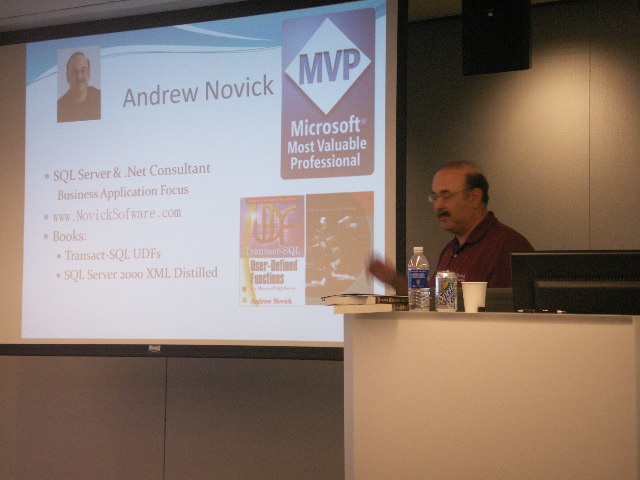
  4. Andy Novick: SQL Azure + lab (http://hmbl.me/1H46PK)
  5. Jim O’Neil: Dallas and OData (http://hmbl.me/1OHC5W)
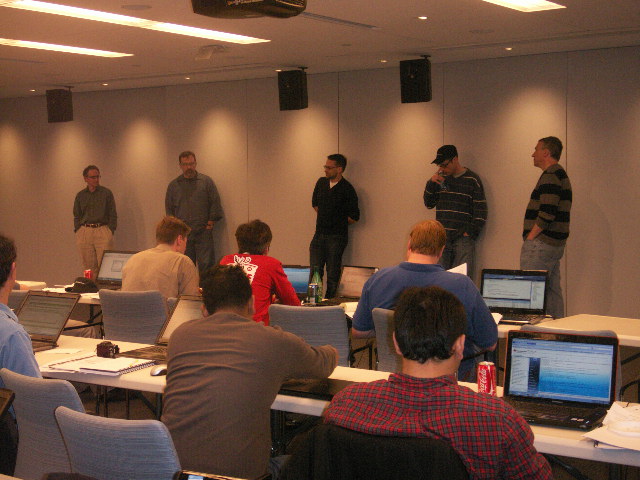
  6. Panel Q&A (in the order shown in photo below): Mark Eisenberg (Microsoft), Bill Wilder, Ben Day, Jason Haley, and Jim O’Neil

After hours, a smaller group unwound at the sports bar over at the Marriott. This included Jim O’Neil, Maura Wilder, Joan Linskey, Bill Wilder, Sri from New Jersey, (okay, other names are vague!) …

Two Roles and a Queue – Creating an Azure Service with Web and Worker Roles Communicating through a Queue

Two Roles and a Queue Lab from Boston Azure Firestarter

At the Firestarter event on May 8, 2010, I spoke about Roles and Queues and worked through a coding lab on same. The final code is available in a zip file. The Boston Azure Firestarter – Bill Wilder – Roles and Queues deck can be downloaded – though since there were so many questions we didn’t get to covering a number many of the slides! – this was a hot topic!

The remainder of this post contains the narrative for the LAB we did as a group at the Firestarter. It probably will not stand alone super well, but may be of interest to some folks, so I’ve posted it.

The following procedure assumes Microsoft Visual Web Developer 2010 Express on Windows 7. The same general steps apply to Visual Studio 2008, Visual Studio 2010, and Web Developer 2008 Express versions, though details will vary.

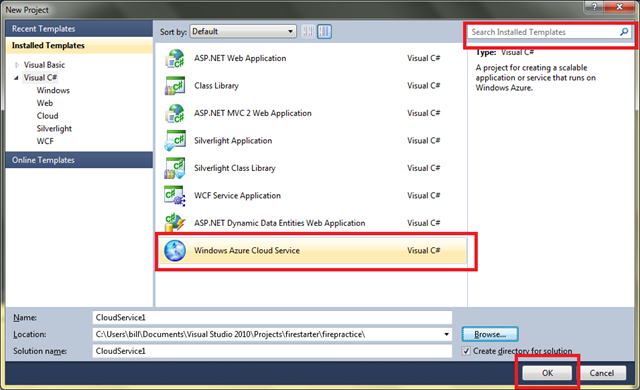
0. Open Microsoft Visual Web Developer 2010 Express and select File | New Project

1. Select Windows Azure Service and click Okay:

image

If you have trouble finding the Windows Azure Service template, you can type “Azure” into the search box in the top-right to narrow the options. Also, if you don’t have the Windows Azure SDK installed, you will need to install that before proceeding – but there will be a link provided by Visual Web Developer 2010 Express that will direct you to the right page. Install it if you need to and try again up to this point.

2. You will see a special dialog box for New Cloud Service Project from which you will add both a Web Role

image

and a Worker Role

image

Verify that both WebRole1 and WorkerRole1 are in the list on the right side, then click OK.

3. Before you begin making code changes, you can run your new application. You can run it in the debugger by pressing the F5 key.

You will probably get the following error message:

image

The error message is telling you that you need to close Visual Web Developer 2010 Express and restart it with elevated privileges.

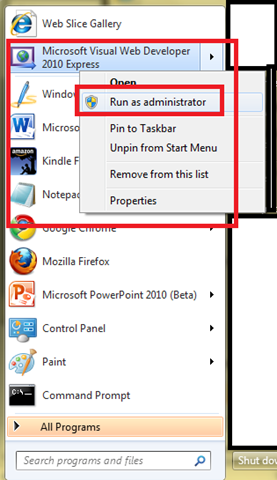
4. To start any Windows program with elevated privileges , right-click on the application then choose Run as administrator from the pop-up menu:

image

Before it obeys your request to run as administrator, Windows 7 will double-check by popping up a security dialog.

Now you can reload your project and try running it again. The app should run and you should see a blank web browser page.

5. Once you’ve proven your application runs, it is time to make some changes.

Make the code changes indicated for the Two Roles and A Queue Lab in CODING STEP 1.

Note: the “coding step 1” and future coding steps were handouts (paper!) at the Boston Azure Firestarter on Sat May 8, 2010. In lieue of reproducing them here, I will post the final solution.

This lab will establish some WebRole basics.

6. When done applying CODING STEP 1, run the application again.

7. After demonstrating your application runs, Deploy it to Azure.

This is a simple application so it helps us get through the initial deployment with minimal challenges.

8. Apply CODING STEP 2 – Add Queue (in local dev fabric storage)

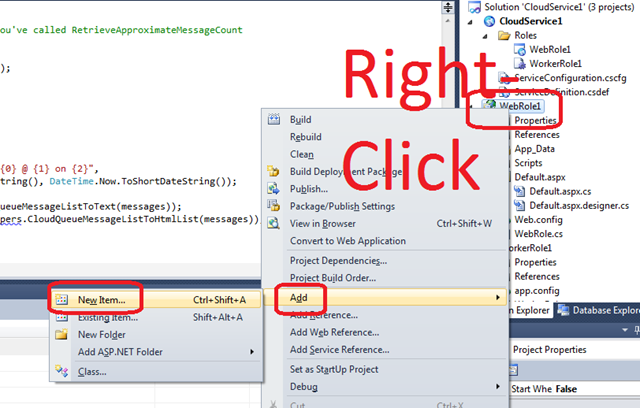
9. CODING STEP 3 – Add “DumpQueue” method and “FirestarterWebRoleHelpers.cs”

image

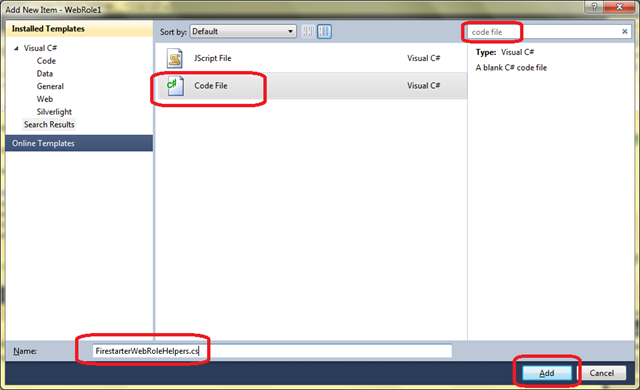
You will get the following dialog box – type “code file” into the search area on the top-right, select Visual C# Code File, and type in the filename “FirestarterWebRoleHelpers.cs” as shown and click Add:

image

The new file “FirestarterWebRoleHelpers.cs” will open in the editor. It should be empty to begin with. Cut and Paste in the contents from http://bostonazure.org/files/FirestarterWebRoleHelpers.cs.txt.

Why? The contents of this file has little to do with Windows Azure, so we don’t want to focus on it. But we want to use some utility routines from it so that we can focus on Azure concepts.

10. CODING STEP 4 – Adding Cloud-based Queue

First we need to configure the cloud.

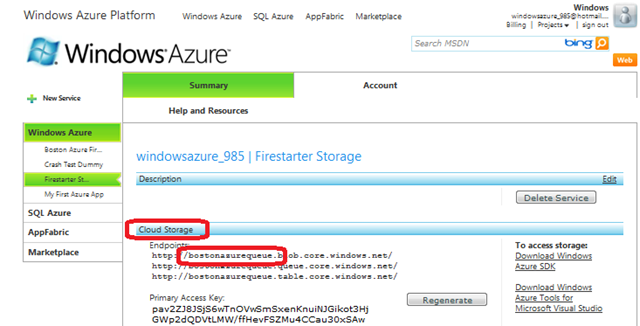
Go to http://windows.azure.com and log in. You may wish to consult instructions on redeeming a token at https://blog.codingoutloud.com/2010/05/06/redeeming-an-azure-token/ or http://bit.ly/dgCuMn

image

Your storage account has a subdomain, as circled above. This – and the Access Key – need to be added to your Web Role and Worker Role so that they can access (and share the same queue within) cloud-hosted storage.

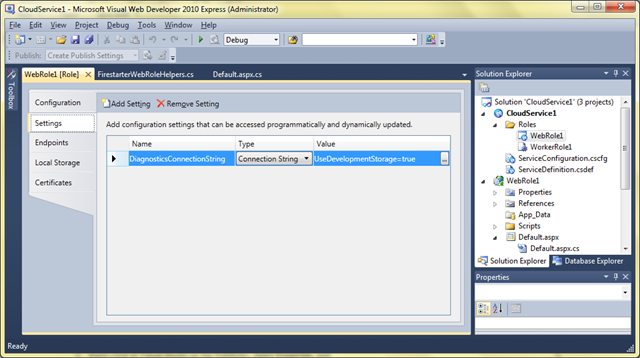
Right-click in Visual Studio on the WebRole1, select Properties, and select the Settings tab on the left. It will appear something like this:

image

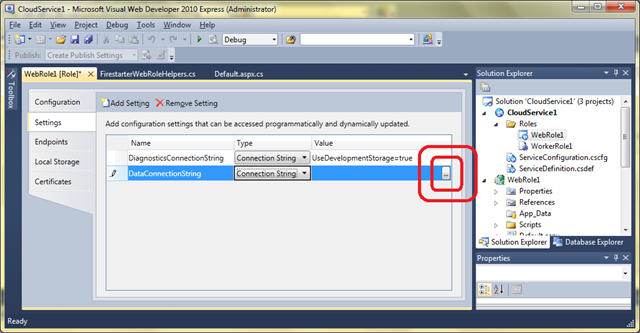
Now click on Add Setting and give the new item the name “DataConnectionString”, the Type “Connection String”, and click on the “…”

image

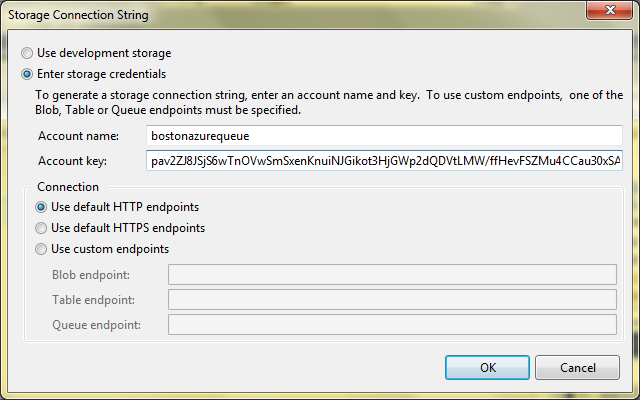
This will bring up the Storage Connection String editor – fill in the fields – where your “Account name” is the same as the subdomain shown on the Storage Service (see above – in that screen shot it is “bostonazurequeue”) and the Key can be either Primary or Secondary Access Key (from same area in the Azure Portal):

image

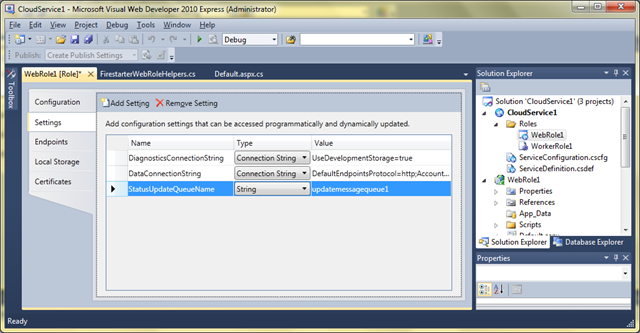
You are NOT DONE in the screen yet. Also add a Setting named “StatusUpdateQueueName”– of Type “String” – with Value “updatemessagequeue1” as follows:

image

Click OK.

11. Now REPEAT BOTH STEPS for WorkerRole1.

Yes, add both Settings also to WorkerRole1 – they both will end up with the same settings. You can “cheat” with cut and paste in the .cscfg and .csdef files.

12. Enable Cloud-hosted Queue from Web Role

Now you are ready go on to make the code changes to use this new configuration item.

Apply CODING STEP 4: Enabling the Cloud-hosted Queue from the Web Role

Now run your application using cloud storage for the queue:

image

Note that you can also examine the contents of the queue online by visiting http://myAzureStorage.com and providing the same credentials you used when setting up the DataConnectionString above for both the Web and Worker roles.

13. Enable Cloud-hosted Queue from Worker Role

Now you are ALMOST ready go on to make the code changes to use this new configuration item.

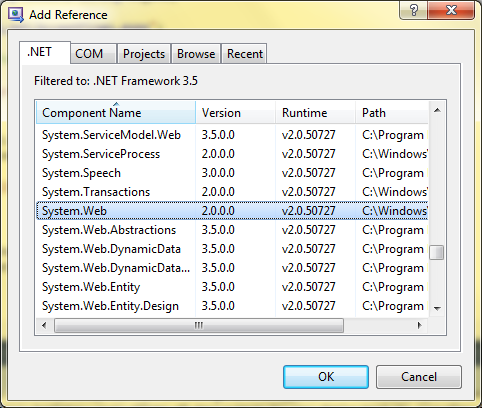
Before applying the coding, we need to add a project reference (otherwise you won’t be able to Resolve use of networking classes used in the FirestarterWorkerRoleHelpers.). In Visual Studio on the right side, under the Solution Explorer, right-click on the References element underneath WorkerRole1 and select Add Reference, then from the .NET tab, select System.Web and click okay:

image

Also, similar to step 9 above, add a new Code File called “FirestarterWorkerRoleHelpers.cs” to hold some additional needed (but not core to Azure) code.

The new file “FirestarterWorkerRoleHelpers.cs” will open in the editor. It should be empty to begin with. Cut and Paste in the contents from http://bostonazure.org/files/FirestarterWorkerRoleHelper.cs.txt.

Now you can apply Apply CODING STEP 5: Enabling the Cloud-hosted Queue from the Worker Role.

14. Deploying to Staging Area in Cloud to Staging

15. Cutover from Staging to Production

16. Add in secret Twitter posting code from your Worker Role…

Yes, this can be done by including a hash character (#) as part of the message you type into your web application.

One Cause of Azure Error – One of the request inputs is out of range

In making some innocuous seeming changes to working code in Windows Azure, I ran into an Exception when creating a Queue – and the cause was not at first obvious. The exception message was “One of the request inputs is out of range” and the inner exception message was “The remote server returned an error: (400) Bad Request.”

Illegal name causes “One of the request inputs is out of range”

Here is the code – why might this Windows Azure code snippet throw an Exception on the call to queue.CreateIfNotExist()?

CloudQueueClient queueStorage = storageAccount.CreateCloudQueueClient();
CloudQueue queue = queueStorage.GetQueueReference(“My Queue”);
bool queueJustCreated = queue.CreateIfNotExist();

The answer lies in the name we are using for the queue. Since the name is just a string, I assumed it can be any string. It cannot be any string.

Experimentation suggests the rules for naming a queue include: (a) use only lower case letters, (b) digits are allowed anywhere, and (c) internal single hyphens are okay too, but (d) name should not contain any spaces (e) nor any punctuation (other than hyphen).

So there would be no problem with valid names like:

  • myqueue
  • my-queue
  • myqueue-3

But there would be problems with illegal names like:

  • MyQueue
  • my queue
  • bill’squeue
  • -nogood
  • x-
  • not—quite
  • bad(name)

There may be additional nuances to the rules I didn’t discover, of course. One way to test out possible names quickly is with the myAzureStorage utility; just try to create a queue using the name and see if you get an error. Note that you can feed upper case chars to myAzureStorage but the created object will return with lower-case letter and will not cause an error.

Also, I only experimented with Queue names, but I assume the same rules apply to Blobs and Tables. Further research indicates this indeed is the case...

My challenge originally was to figure out why I got the Exception that was raised – that was the non-obvious part – the exception message did not tell me it was a problem with the name. After I figured it out and experimented a bit, of course then I found the documentation on allowed names which supports my conclusions… and adds details like length of name and the fact that the name is required to be a legal DNS name.

Redeeming an Azure Token

At some select events (like Boston Azure Firestarter, Boston Azure User Group hands-on meeting, or even Protein Folding with Azure @home), Microsoft sometimes provides tokens for participants who wish to try out Windows Azure for real – by deploying real bits into the cloud – deploying multiple instances of Web Roles and Worker Roles, using Queue for scaling, storing data and blobs in Azure Storage and exercising SQL Azure… Some of the tokens are good for up to 4 weeks – which is awesomely convenient for really kicking the tires on Azure if you are a developer. Which I am… Here is a little guidance on getting your account set up once you have a token in hand.

Note that you will be interacting with the Windows Azure Developer Portal (or Dev Portal for short) to redeem your token and establish your temporary account. The Dev Portal is useful to learn about and get to know.

1. First visit http://windows.azure.com and log in with the provided credentials. Use the provided email address for your Windows Live ID.

(NOTE: If any of the images in this post are too small to read, click on them to see a larger version.)

image

2. You will see a screen like the following. Note the row with the light blue background; this background color only appears when your mouse is hovering there. Click on the Project Name that matches your token account name.

image

(Notice that the account owner is “waaccts@microsoft.com” – this is because you are using a Token. Azure supports having an overall account that pays the bills, then sub-accounts for developers. This is an example.)

3.  Now you are in! You can proceed to review some of the help resources lists, or click around on any of the tabs to the left. But to create a new application that you can host on the Azure cloud, you can click on the “New Service” link next to the green “+” sign.

image

4. After you choose “New Service” you will see the following. Note the two main options in the middle for Storage Account and Hosted Services.

image 

Select Hosted Services to begin. Be sure to click on the words “Hosted Services” as opposed to the “Learn More” link, as they are different.

5. The next page will ask you for a name – this name will only be used to help you identify this service from a list in the developer portal, so don’t spend too much time coming up with the perfect name. You don’t need to provide anything for the Description.

image

After providing a name, click Next.

6.  Now you are faced with a form where the choices you make actually do matter.  Here’s what’ you’ll need to do:

image

Type in a “Public Service Name” – this will be the Internet-visible sub-domain from which your deployed application will be visible. For example, if you choose “foo” then your Azure Service will live at http://foo.cloudapp.net after you publish it.

After you settle on a Public Service Name (using Check Availability button as need), you also need to select a Region. Pick the “anywhere” region in your continent (or closest to your continent) such as Anywhere US and click Create.

Here’s what mine looked like before I clicked Create:

image

Now your Azure Service has been created.

7. You will see a screen inviting you to Deploy a Hosted Service Package. We won’t do that now (though you could if you had an application ready). Instead, we will create an Azure Storage Account. From here:

image

Click on the “New Service” link which is near the top-left – below the large Windows Azure logo – and you will see the same screen you saw in step 4:

 image

This time select Storage Account and you will see the following:

image

Give it a name, as I did in screenshot, and click Next.

8. As in step 5, this is also an important choice, though not visible to humans visiting your site. You will need to know this address to program against it. Of course you can look it up in the Dev Portal at any time, but why not choose a logical name. Fill in the fields similar to step 5 – be sure to choose the same Region you chose with step 5 – and click Create.

image

9. You are now ready to build and deploy Azure applications that use Web Roles, Worker Roles, and various kinds of storage.

You will need the keys shows to programmatically access your storage.

image

You can always come back and look up the values of these keys, of course. Also, if a key is compromised, you can regenerate it easily, invalidating the prior one. There are two separate keys that can be used/invalidated independently. These keys are specific to this Storage Service you created; you can create more Storage Services with different keys and even use multiple of them together.

Enabling IIS on Windows 7

Azure developers running Windows 7 (and Vista should be similar) will want to enable IIS 7.5 on the desktop. This will make it possible to run the local development environment known as the Azure Dev Fabric.

Five easy steps to Enable IIS 7.5 for Windows 7 Developers

1. Open Control Panel. From the Search Control Panel search box in the top right, type in “turn windows features on or off” to show just this option. Click on the “Turn Windows features on or off” link underneath the “Programs and Features” heading.

This launches the Control Panel applet you will need.

Here are the Control Panel screens you will now see:

(If the graphics are too small for you, click on them to bring up a larger version.)

image

Eventually it loads.

2. Once loaded, scroll down to Internet Information Services as shown below, and check the desired boxes (the one I chose are shown in the next two screen shots):

(If the graphics are too small for you, click on them to bring up a larger version.)

image

image

3. The hit okay and wait …

image

4. Once complete, you will see this browser window – note the yellow bar:

image

5. You may want to select “Enable Intranet Settings” as shown below:

image

Done!