Category Archives: AI

GitHub Copilot Agent Mode for the Win: I added a new Tool to MCP Server with Single Prompt

Along with fellow panelists Jason Haley, Veronika Kolesnikova (the three of us run Boston Azure AI), and Udaiappa Ramachandran (he runs Nashua Cloud .NET & DevBoston), I was part of a Boston Azure AI event to discuss highlights from Microsoft’s 2025 Build conference. I knew a couple of the things I wanted to show off were GitHub Copilot Agent mode and hosting Model Context Protocol (MCP) tools in Azure Functions.

What I didn’t realize at first was that these would be the same demo.

I started with a solid sample C#/.NET MCP server ready to be deployed as an Azure Function (one of several languages offered). The sample implemented a couple of tools and my goal was to implement an additional tool that would accept an IP address and return the country where that IP address is registered. The IP to country code mapping functionality if available as part of Azure Maps.

I started to hand-implement it, then… I decided to see how far GitHub Copilot Agent mode would get me. I’ve used it many times before and it can be helpful, but this ask was tricky. One challenge being that there was IaC in the mix: Bicep files to support the azd up deployment, AVM modules, and many code files implementing the feature set. And MCP is still new. And the MCP support within Azure Functions was newer still.

Give GitHub Copilot Agent a Goal

The first step was to give the GitHub Copilot Agent a goal that matches my needs. In my case, I gave Agent mode this prompt:

The .NET project implements a couple of Model Context Protocol (MCP) tools – a couple for snippets and one that says hello. Add a new MCP tool that accepts an IPv4 IP address and returns the country where that IP address is registered. For example, passing in 8.8.8.8, which is Google’s well-known DNS server address, would return “us” because it is based in the USA. To look up the country of registration, use the Azure Maps API.

And here’s what happened – as told through some screenshots from what scrolled by in the Agent chat pane – in a sequence that took around 12 minutes:

I can see some coding progress along the way:

A couple of times the Agent paused to see if I wanted to continue:

It noticed an error and didn’t stop – it just got busy overcoming it:

It routinely asked for permissions before certain actions:

Again, error identification – then overcoming errors, sometimes by getting more up-to-date information:

Second check to make sure I was comfortable with it continuing – this one around 10 minutes after starting work on the goal:

In total 9 files were changed and 11 edit locations were identified:

Deploy to Azure

Using azd up, get it deployed into Azure.

Add MCP Reference to VS Code

Once up and running, then I installed it in VS Code as a new Tool – first click on the wrench/screwdriver:

Then from the pop-up, scroll the the bottom, then choose + Add More Tools…

Then follow the prompts (and see also instructions in the GitHub repo):

Exercise in VS Code

Now that you’ve added the MCP server (running from an Azure Function) into the MCP host (which is VS Code), you can invoke the MCT tool that accepts an IP and returns a country code:

domain-availability-checker% dig A en.kremlin.ru +short
95.173.136.70
95.173.136.72
95.173.136.71
domain-availability-checker%

Using the first of the three returned IP addresses, I ask within the Agent chat area “where is 95.173.136.70 located?” – assuming that the LLM used by the chat parser will recognize the IP address – and the need for a location – and figure out the right MCT tool to invoke:

I give it one-time permission and it does its thing:

Victory!

Check Code Changes into GitHub

Of course, using GitHub Copilot to generate a commit message:

Done!

Connect with Bill and Boston Azure AI

Talk: Empowering AI Agents with Tools using MCP

Last night I had the pleasure of speaking to two simultaneous audiences: Nashua Cloud .NET & DevBoston community tech groups. The talk was on Model Context Protocol (MCP) which, in a nutshell, is the rising star for answering the following question: What’s the best way to allow my LLM to call my code in a standard way?

There is a lot in that statement, so let me elaborate.

First, what do you mean by “the best way to allow my LLM to call my code” — why is the LLM calling my code at all? Don’t we invoke the LLM via its API, not the other way around? Good question, but LLMs can actually invoke your code. Because this is how LLMs are empowered to do more as AI Agents. Think about an AI Agent as an LLM + a Goal (prompts) + Tools (code, such as provided by MCP servers). The LLM uses the totality of the prompt (system prompt + user prompt + RAG data + any other context channeled in via prompt) to understand the goal you’ve given it then it figures out which tools to call to get that done.

In the simple Azure AI Agent I presented, its goal is to deliver an HTML snippet that follows HTML Accessibility best practices in linking to a logo it tracks down for us. One of the tools is web search to find the link to the logo. Another tool validates that the proposed link to the logo actually resolves to a legit image. And another tool could have been to create a text description of the image, but I made the design choice to leave that up to the Agent’s LLM since it was multimodel. (My older version had a separate tool for this that used a different LLM than the one driving the agent. This was an LLM with vision capabilities – which is still a reasonable idea here for multiple reasons, but kept it simple here.)

Second, what do you mean by “in a standard way” – aren’t all LLMs different? It is actually the differences between LLMs that drives the benefits of a standard way. It has been possible for a while to allow your LLM to call out to tools, but there were many ways to do this. Now doing so according to a cross-vendor agreed-upon standard, which MCP represents, lowers the bar for creating reusable and independently testable tools. And marketplaces!

Remember many challenges remain ahead. There are a few others in the deck, but here are two:

First screenshot reminds that there are limits to how many MCP tools an LLM (or host) can juggle; here, GitHub Copilot currently is capping at 128 tools, but you can get there quickly!

Second screenshot reminds that these are complex operational systems. This “major outage” (using Anthropic’s terminology) was shortly before this talk so complicated my planned preparation timel. But it recovered before the talk timeslot. Phew.

Connect with Bill and Boston Azure AI

Links from the talk

  1. Assorted Cranking AI resources ➞ https://github.com/crankingai
  2. Code for the Agent ➞ https://github.com/crankingai/logo-agent
  3. Code for the Logo Validator MCP tool ➞ https://github.com/crankingai/logo-validator-mcp
  4. Code for the Brave Web Search MCP tool ➞ https://github.com/crankingai/brave-search-mcp
  5. Images I used in the example ➞ https://github.com/crankingai/bad-images (https://raw.githubusercontent.com/crankingai/bad-images/refs/heads/main/JPEG_example_flower-jpg.png)

Anthropic status page ➞ https://status.anthropic.com/ (see screenshot above).

Model Context Protocol (MCP) Resources

Standards & Cross-vendor Cooperation

SDKs & Samples

MCP Servers & Implementations

Popular MCP Servers

  • GitHub MCP Server – GitHub’s official MCP server that provides seamless integration with GitHub APIs for automating workflows, extracting data, and building AI-powered tools. In case you’d like to create a Personal Access Token to allow your GitHub MCP tools to access github.com on your behalf ➞ https://github.com/settings/personal-access-tokens
  • Playwright MCP Server – Microsoft’s MCP server that provides browser automation capabilities using Playwright, enabling LLMs to interact with web pages through structured accessibility snapshots.
  • MCP Servers Repository – Collection of official reference implementations of MCP servers.
  • Popular MCP Servers Directory – Curated list of popular MCP server implementations.

MCP Inspector Tool ➞ Check this out for sure

Download the deck from the talk ➞

Talk: Human Language is the new UI. How does this work? at the AI Community Conference – AICO Boston event! #aicoevents

The organizers of the AI Community Conference – AICO Boston event did an incredible job. The conference was first-rate and I really enjoyed engaging with attendees and speakers, while learning from everyone.

I delivered a new iteration of my talk on how it is possible to have Human Language as the new UI, thanks to LLMs and Embedding models. There was an engaged and inquisitive group! The resources I used during the presentation, including my deck, are all included below.

Connect with Bill or other related resources:

Links from the talk:

  1. Assorted Cranking AI resources ➞ https://github.com/crankingai
  2. The funwithvectors.com app used in the talk ➞ https://funwithvectors.com and OSS repo
  3. The repo with code for the “next-token” project that I used to show how tokens have probabilities and how they are selected (and can be influenced by Temperature and Top-P which is also known as nucleus sampling) ➞ https://github.com/crankingai/next-token
  4. The OpenAI Tokenizer shown in the talk ➞ https://platform.openai.com/tokenizer/

The deck from the talk:

  1. The deck from the talk ➞

Talk: Human Language is the new UI. How is this possible? at Memphis Global AI Community Bootcamp event!

Earlier today I spoke at the Memphis edition of the Global AI Bootcamp 2025 hosted by the Memphis Technology User Groups. My talk was “Human Language is the new UI. How is this possible?” and resources and a few notes follow. Thank you Douglas Starnes for organizing! It was similar to, but not identical to, the recent talk I gave. And next time it will be different again. 😉

This is from the https://funwithvectors.com app I used to show vectors in action:

┃┃┃┃┃┃┃┃┃┃┃┃┃······· ⟪0.64⟫ → ‘doctor’ vs ‘physician’
┃┃┃┃┃┃┃┃┃┃┃┃┃······· ⟪0.67⟫ → ‘doctor’ vs ‘dr.’
┃┃┃┃┃┃┃┃┃┃·········· ⟪0.48⟫ → ‘physician’ vs ‘dr.’

The above is intended to illustrate the non-transitive nature of the “nearness” of two vectors. Just because “doctor” & “physician” are close and “doctor” & “dr.” are close does NOT mean “dr.” & “physician” are as close.

Connect with Bill or other related resources:

Links from the talk:

  1. Cranking AI resources (including source to funwithvectors.com app) ➞ https://github.com/crankingai
  2. The funwithvectors.com app used in the talk ➞ https://funwithvectors.com
  3. The OpenAI Tokenizer shown in the talk ➞ https://platform.openai.com/tokenizer/

The deck from the talk:

  1. The deck from the talk ➞ https://blog.codingoutloud.com/wp-content/uploads/2025/04/memphisglobalai-humanlanguageisnewui-25-apr-2025_pub.pptx

Talk: Human Language is the new UI. How is this possible? at Global AI Bootcamp 2025 – Cleveland edition

Earlier today I spoke at the Cleveland OH edition of the Global AI Bootcamp 2025 hosted by Sam Nasr of the Cleveland Azure group. My talk was “Human Language is the new UI. How is this possible?” and resources and a few notes follow.

This is from the https://funwithvectors.com app I used to show vectors in action:

Connect with Bill or other related resources:

Links from the talk:

  1. Cranking AI resources (including source to funwithvectors.com app) ➞ https://github.com/crankingai
  2. The funwithvectors.com app used in the talk ➞ https://funwithvectors.com
  3. The OpenAI Tokenizer shown in the talk ➞ https://platform.openai.com/tokenizer/

The deck from the talk:

  1. The deck from the talk ➞

Talk: Boston Code Camp 38 – Let’s Build a Goal-Oriented AI Agent Using Semantic Kernel

29-Mar-2025

Today I attended and contributed a talk to the Boston Code Camp 38 (yes, impressively, the 38th edition of this event). I made the trip with Maura (she gave a talk combining Cryptocurrency And Agentic AI) and Kevin (he gave a talk on Top 10 AI Security Risks). and we got to hang out with and chat with so many cool people from the Boston technology community.

The description of my Let’s Build a Goal-Oriented AI Agent Using Semantic Kernel talk follows, followed by a couple of relevant links, then the slide deck.

Imagine an AI not limited to answering individual questions or chatting, but actively working towards a goal you’ve assigned to it.

In this session, we’ll explore the building of an AI Agent – an autonomous actor that can execute tasks and achieve objectives on your behalf.

Along the way we will demystify:

1. 🧠 LLMs – What is a Large Language Model (LLM)
2. 📚 Tokens – What is a token and what are its roles
3. 💡 Embeddings – What are embedding models and vectors and what can they do for us
4. 🎯 Prompts – Beyond the basics
5. ⚙️ Tools – How can these be created and accessed using Semantic Kernel
6. 🤖 Agents – Let’s put all these concepts to work!

The end result will be the core (or perhaps ‘kernel’ 😉) of an AI Agent – your virtual coworker willing to handle tasks on your behalf without. It will be built in C# using the open source, cross-platform Semantic Kernel library.

This talk assumes user-level familiarity with LLMs like ChatGPT or Microsoft Copilot and basic prompting. Anything else will be explained.

(stole photo from Robert Hurlbut)

A couple of prominent links from the talk are:

You can find the Fun with Vectors tool here: https://funwithvectors.com/

You can find the OpenAI Tokenizer tool here: https://platform.openai.com/tokenizer

Download the slides here:

Talk: AI for Application Architects

Last night I was guest speaker at the Boston .NET Architecture community group. I learned they are now 21-year-olds. That’s a long track record! The audience had some insightful questions, which I always appreciate.

My talk focused on the perspective of the application architect – and not the data scientist, for example – in how the process works and what are some areas I would need to dig into.

Here’s the alternative talk description I offered a few days ago:

Interested in understanding how LLMs are created and how they work internally, including all the in-depth data science and machine learning techniques? If so, then this is not that talk. Rather, this talk steps back to treat the LLM as a black box. And then steps further back to treat the LLM as a part of a cohesive system offered over the internet through an API. It is from that perspective that we begin our exploration.

How exactly does an application make use of LLM services? Is this thing secure? Is it private? Am I operating according to Responsible AI principles? (Oh, and what are Responsible AI principles?) Is it accurate? Is it portable? And of course, when does it stop being a Chatbot and start being an Agent?

These are some of the key types of application architecture considerations we will discuss as we start with “the humble chatbot demo” then turn it into an Agent and then see what it would take to put that into production.

The deck is here:

The recording is here: https://youtu.be/UJutO4eFLZg

Talk: Building an Agent with Semantic Kernel

Today I attended and spoke at the 37th Boston Code Camp. The rainy weather was just enough to maximize attendance.

There was an incredibly energetic group of inquisitive people at my talk which was on how you can give your AI LLM a goal and some tools and let it figure out how to move ahead! Lots of questions came from this highly engaged group.

The details of my talk follow.

Building an AI Agent with Semantic Kernel

The classic approach to managing complexity is through abstraction. While also useful in the physical world (you can know how to use a “car” without needing to know about all the parts under the hood), it is an essential tool in software.

To program against the current generative AI models you can use the model’s native abstraction (their SDK). But there are other options too, one of which is to use Semantic Kernel, an open-source library from Microsoft.

In this talk we will understand the first-class abstractions representable using Semantic Kernel, from the granular Function and building up to an Agent, and a couple of steps in between.

This talk will be a mix of explaining AI-relevant and Semantic Kernel-relevant topics + some explanatory sample code. We may also sneak in a little Prompty.

By the end of this talk you will appreciate why you might (or might not) want to build your AI solution with Semantic Kernel (SK) and how you would approach it.

This talk will assume you have used LLMs (like ChatGPT or others) and know the very basics of iterating on prompts and experiencing that GenAI systems have an ability to make decisions from human language. Anything beyond this will be explained in the talk.

The sample application used in the talk can be found here:

https://github.com/semantickerneldev/icon-agent

The deck used in the talk can be found here:

Talk: Season of AI at Boston Azure

Last night at Boston Azure I teamed up with Jason Haley to cover the current Azure AI topics from the Microsoft-created Season of Azure program. An engaged group showed up at NERD in Cambridge to hear all about it.

Jason Haley’s code and materials are here: https://jasonhaley.com/2024/06/25/boston-azure-june-2024/

For my part, I pulled content from Generative AI for .NET Developers and Getting Started with Azure AI Studio and blended in some of my own. The combined mega-deck is attached to this post, though the deck spans much more than I had time to go through.

If you attended and have not had opportunity to give some feedback to Microsoft, there are only a few quick questions.

Take the survey here: aka.ms/AttendeeSurveySeasonOfAI

Additional Resources

Also complements of the Season of AI team, check out these resources.

Join the Azure AI Community on Discord

Connect with fellow enthusiasts, engage with Microsoft experts and MVPs, discuss your favorite sessions, and delve into AI discussions. Your space to ask, share, and explore!

aka.ms/AzureAI/Discord

Get started skilling with AI on Microsoft Learn

Build AI skills, connect with the community, earn Microsoft Credentials, learn from experts, and take the Cloud Skills Challenge.

aka.ms/LearnAtAITour

Download Deck Bill Presented

A diagram we spent time on (slightly updated, source here):

And finally, the deck I used follows:

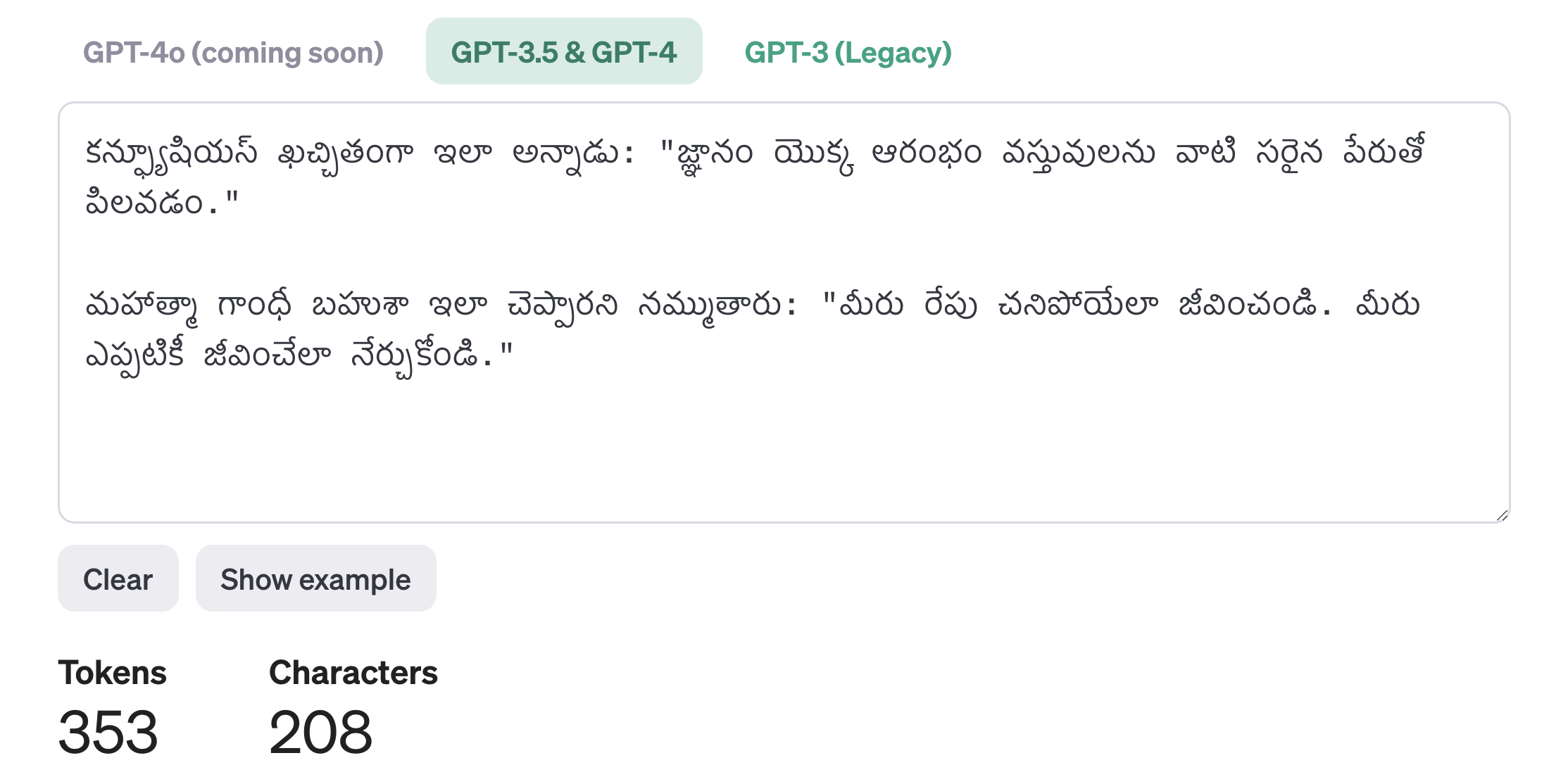
And here are a couple of the links I showed during the talk that got a lot of discussion or attention:

  1. https://platform.openai.com/tokenizer
  2. https://platform.openai.com/docs/models/gpt-4-turbo-and-gpt-4

Recall the third one shown – Telugu – was wildly more expensive (in terms of token count) than English (50 tokens) and Chinese (75 tokens) – where Telugu weighed in at 353 tokens.

Talk: Top AI Highlights from Microsoft Build 2024 from Boston Azure

Last night at Virtual Boston Azure I teamed up with Jason and Veronika and the three of us covered some of the topics from Microsoft Build 2024 that we found most impactful and interesting.

Here’s a direct link to the video on the Boston Azure YouTube channel: https://www.youtube.com/watch?v=odwHlnk_tzI and the same video is embedded immediately below.